
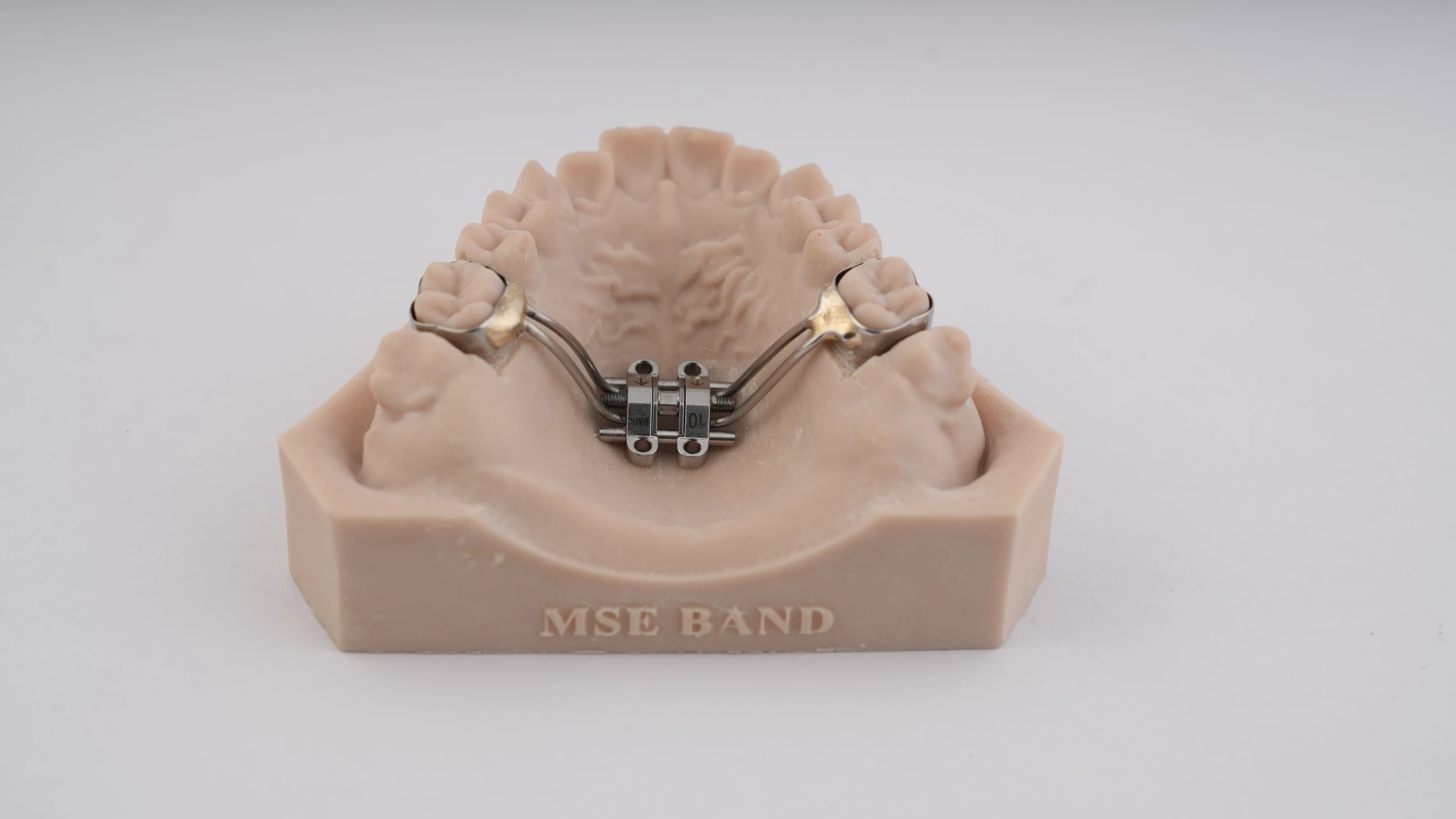
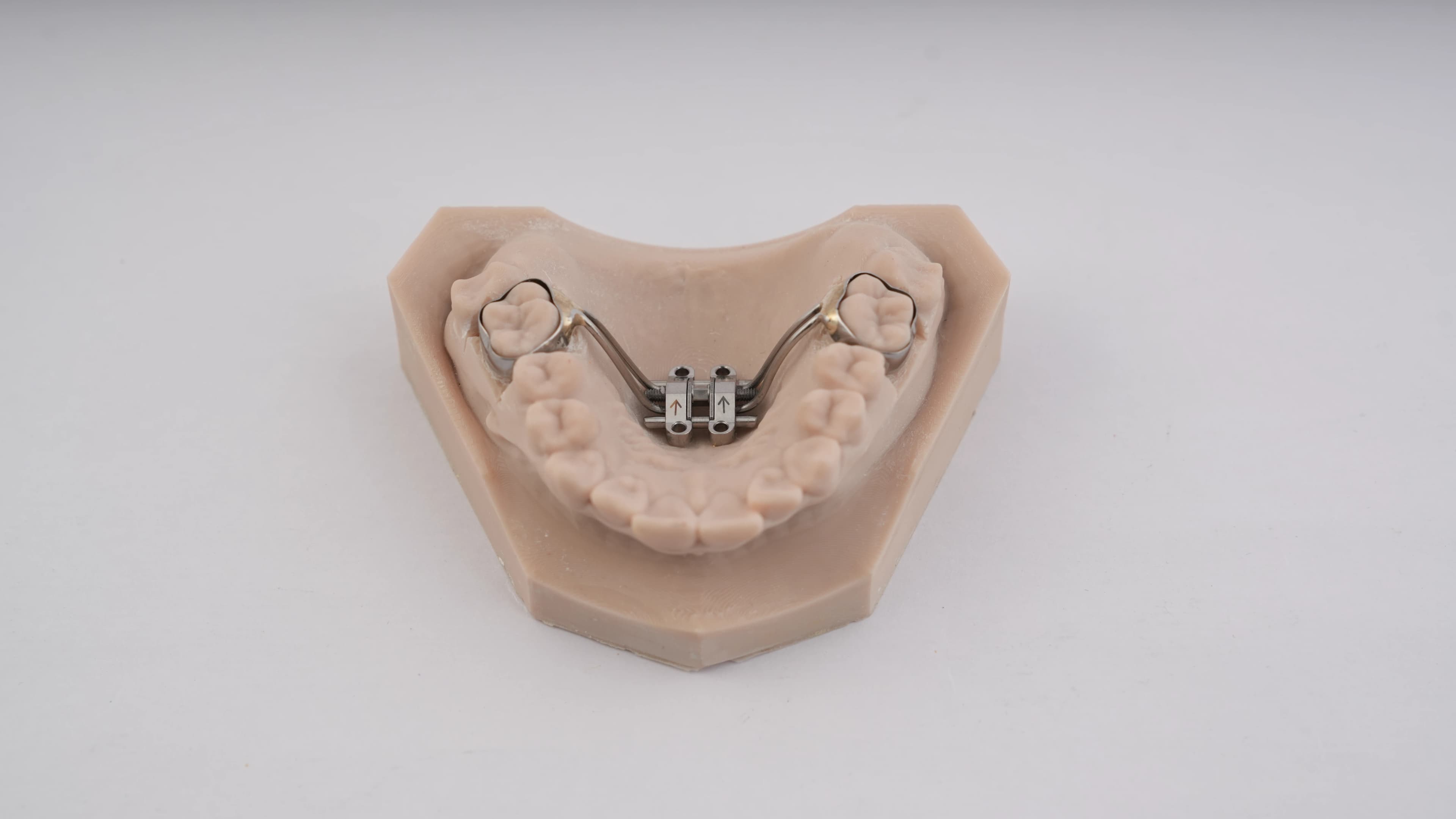
Maxillary Skeletal Expander (MSE – Banded)
Indications:
Skeletal maxillary transverse deficiency in late adolescents/young adults.
Posterior cross bite due to skeletal constriction.
Maxillary constriction with nasal airway compromise (OSA, mouth breathing).
Pre-surgical expansion (SARME alternative when feasible).
Contraindications:
Severe transverse deficiency in fully mature adults (requires SARME).
Poor bone quality/periodontal compromise.
Patients unwilling/unable to tolerate miniscrew anchorage.
Palatal pathology or insufficient palatal bone thickness.
Corrects:
Skeletal transverse maxillary deficiency by splitting midpalatal suture (or basal bone expansion in older patients).
Relieves dental crowding by increasing arch perimeter.
Improves nasal airway volume as ancillary effect.
Design:
Expansion screw (jackscrew) positioned in posterior palate.
Four mini implants (temporary anchorage devices) inserted bicortically (penetrating both palatal and nasal floors).
Appliance is banded to upper first molars ± premolars to provide dental support in addition to skeletal anchorage.
Expansion rate: typically 2 turns/day (~0.25 mm/turn) until desired expansion achieved.
Philosophy:
A MARPE (miniscrew-assisted rapid palatal expansion) system designed by Prof. Won Moon (UCLA).
Hybrid anchorage → combines skeletal anchorage (miniscrews) with dental bands for stabilization.
Produces true skeletal expansion in young adults where conventional RME fails.
Distributes orthopedic forces to basal bone and minimizes dental tipping.
Modifications:
Bonded version (with acrylic coverage of posterior teeth) for vertical control.
Surgically assisted version (SARME + MSE) in adults with heavily interdigitated sutures.
Can be combined with facemask for protraction in Class III correction.
MSE with buccal miniscrews to reinforce anchorage further.
Advantages:
· Skeletal anchorage–assisted expansion – combines bands on molars with mini-screw fixation for stable, orthopedic expansion.
· Predictable skeletal effects – splits the midpalatal suture efficiently, minimizing unwanted dental tipping.
· Banded design – distributes force through molar bands as well as skeletal anchorage, enhancing stability.
· Effective in late adolescents and adults – expands maxilla even after sutural maturation.
· Improved airway benefits – can enhance nasal airflow by widening nasal cavity.
· Non-surgical alternative – avoids SARPE in many borderline adult cases.
· Integration with fixed appliances – can be combined with braces or aligners during comprehensive treatment.
· Customizable screw design – allows slow or rapid expansion depending on clinical goals.
Good patient tolerance – less bulky compared to acrylic expanders