
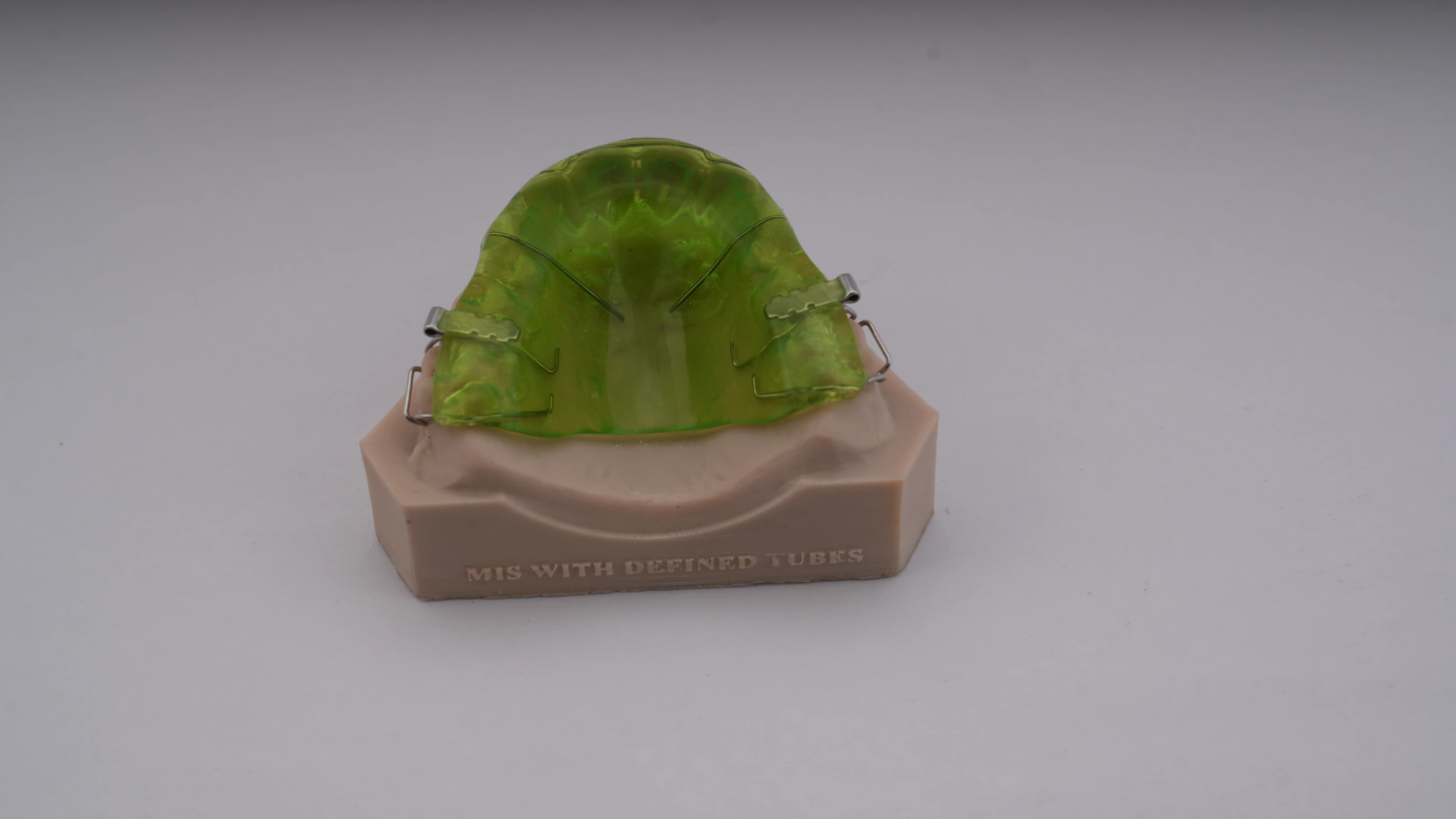
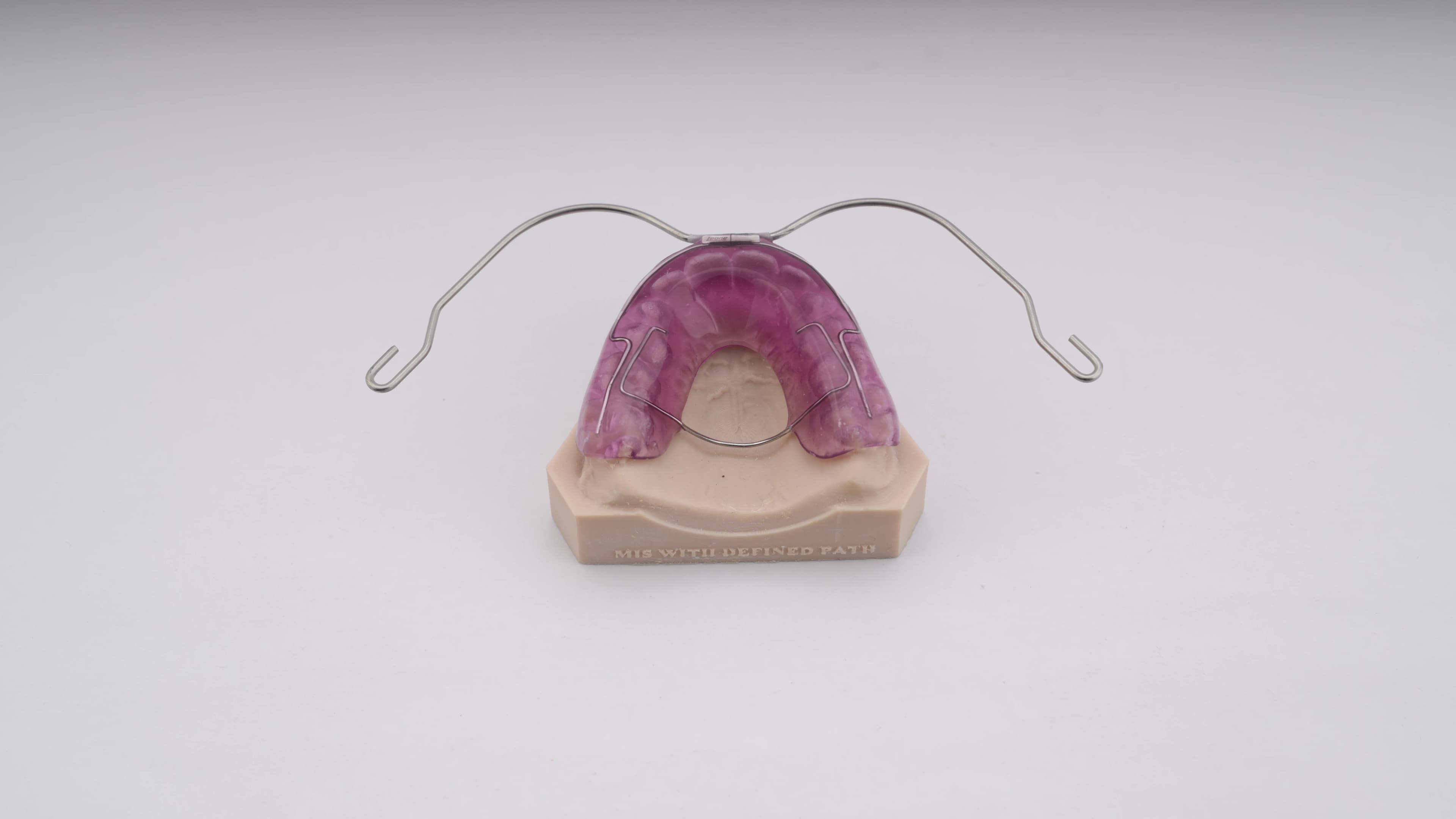
Maxillary Intrusion Splint with Tubes
Indications:
Skeletal or dentoalveolar anterior open bite due to posterior maxillary over-eruption.
Vertical maxillary excess in growing or young adult patients.
Pre-surgical orthodontics to reduce posterior vertical dimension.
Patients needing molar intrusion with stable force delivery.
Contraindications:
Poor periodontal support of posterior teeth.
Severe skeletal vertical discrepancies needing orthognathic impaction.
Non-compliant patients if combined with extraoral traction.
Poor oral hygiene (risk of decalcification under splint).
Corrects:
Intrudes maxillary molars and premolars.
Allows counter-clockwise autorotation of mandible → improves anterior open bite.
Reduces lower anterior facial height.
Improves interlabial gap and facial esthetics.
Design:
Full occlusal coverage acrylic splint over posterior teeth (premolars and molars).
Incorporates stainless steel tubes (labially or buccally positioned) soldered to molar bands or embedded into the splint.
Tubes serve as force delivery channels – to receive high-pull headgear, transpalatal arch wires, or vertical elastics.
Splint ensures rigid coupling of posterior teeth, distributing intrusive forces evenly.
Philosophy:
Provides anchorage control and force guidance through tubes.
Delivers intrusive orthopedic forces (~100–150 g per molar) via headgear, elastics, or skeletal anchorage connected to tubes.
Prevents tipping of individual molars by uniting teeth into one block.
Aims for controlled intrusion → mandibular autorotation → closure of open bite.
Modifications:
Tubes can be oriented for different vectors (more vertical or oblique intrusion).
Can be combined with high-pull headgear for vertical control.
Mini-implant anchorage can be used with elastics engaged into tubes (MIAS – mini-implant assisted splint).
Bite-block extensions can be added to restrict eruption of incisors
Advantages:
· Combines splint stability with extraoral anchorage → allows efficient transfer of orthopedic forces.
· Provides vertical control → intrudes maxillary molars, reducing vertical dimension and anterior open bite.
· Effective in high-angle & vertical growers → helps redirect growth pattern favorably.
· Distributes headgear forces evenly across maxillary posterior teeth, minimizing localized stress.
· Secure splint retention → prevents dislodgement during headgear wear.
· Reduces risk of unwanted dental tipping compared to banded headgear.
· Enhances orthopedic effect of headgear → maxillary growth restriction or redirection with vertical control.
Custom fabricated by MaxDent → ensures precision fit, comfort, and durability for better compliance