
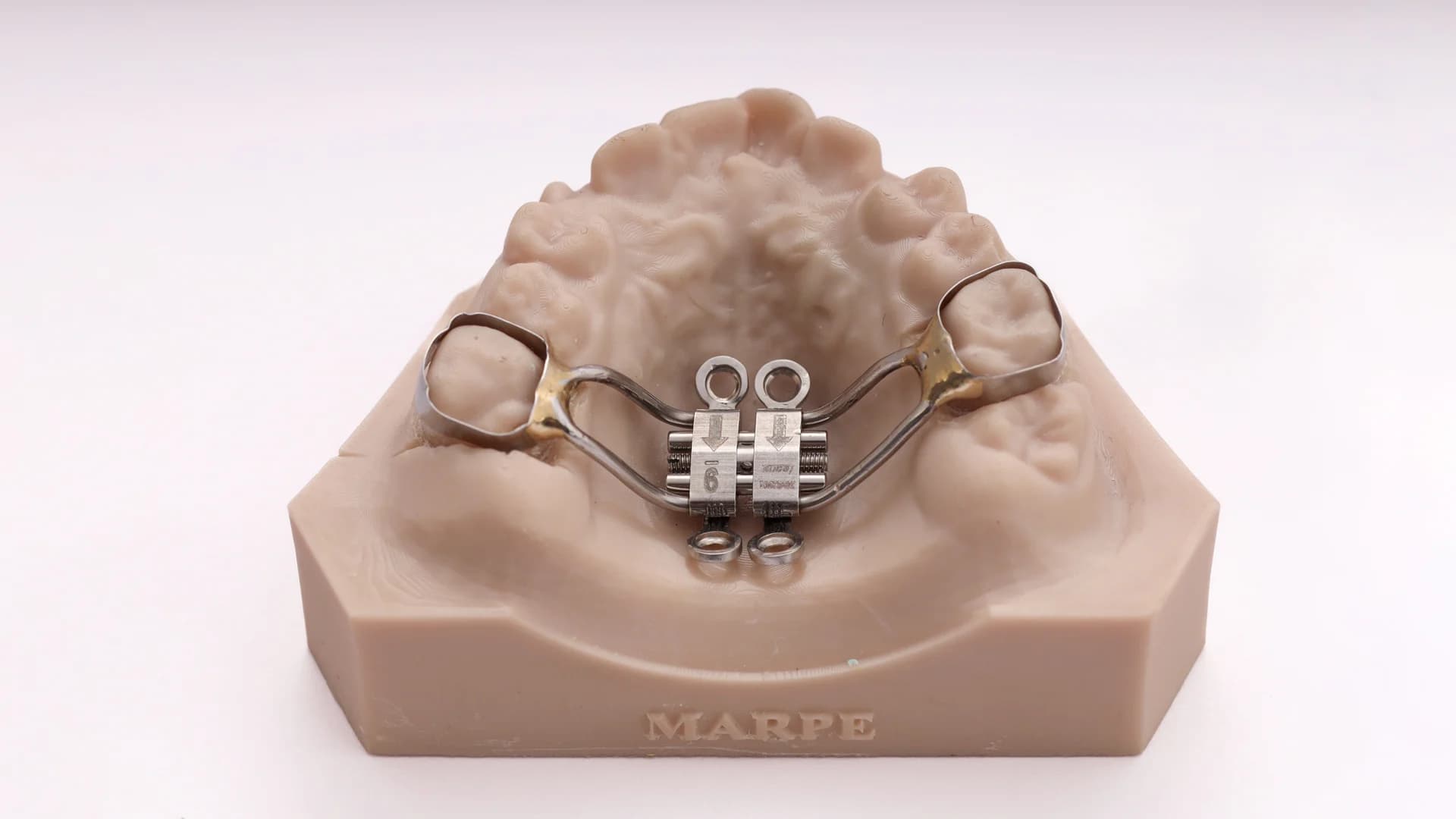
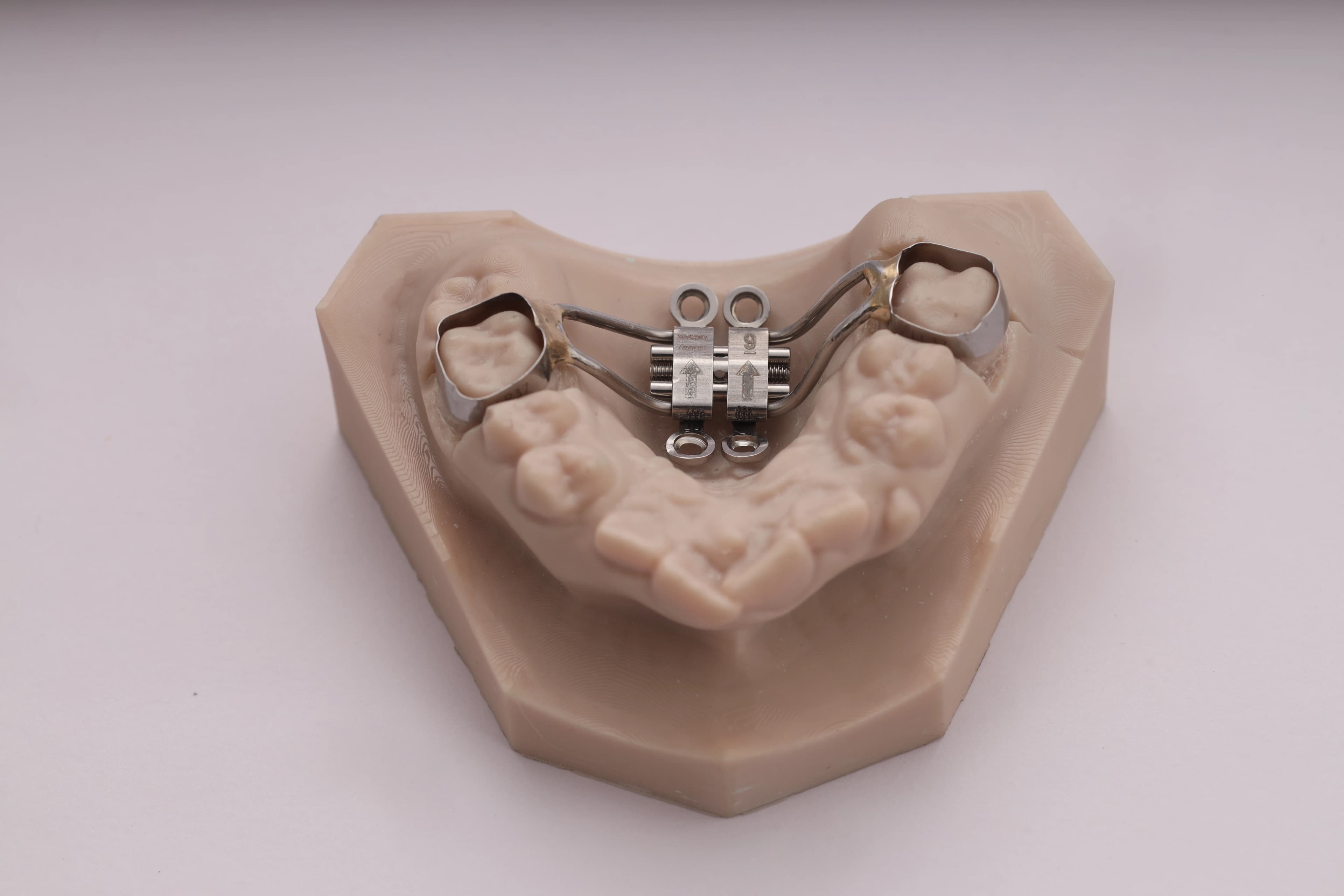
MARPE – Banded
Indications:
Skeletal maxillary transverse deficiency in late adolescence/young adulthood (when midpalatal suture is maturing).
Posterior crossbite (skeletal origin).
Relieving moderate crowding by gaining arch perimeter.
Pre-protraction in Class III cases (with facemask).
Patients requiring non-surgical alternative to SARME.
Contraindications:
Fully fused/interdigitated midpalatal suture in older adults (requires SARME).
Poor palatal bone support or inadequate bone thickness.
Severe vertical growers (may worsen open bite).
Poor oral hygiene/periodontal compromise.
Corrects:
Skeletal transverse maxillary deficiency → orthopedic expansion.
Posterior dental crossbite (secondary correction).
Increases nasal cavity volume → improves airway.
Crowding relief (limited).
Design:
Central expansion screw (jackscrew) with slots for miniscrew insertion.
4–6 miniscrews (TADs) inserted through the jackscrew into palatal bone → bicortical engagement (palatal + nasal floor).
Banded to first molars ± premolars to stabilize appliance.
Force applied: ~0.25 mm per turn, usually 2 turns/day until expansion goal achieved.
Philosophy:
Hybrid anchorage system → distributes forces both skeletally (via miniscrews) and dentally (via bands).
Provides true skeletal expansion in cases where conventional RME would cause only dental tipping.
Orthopedic forces are transmitted directly to basal bone → minimizes dental side effects.
Intermediate option between RME (tooth-borne) and MSE (bone-borne hybrid with higher rigidity and bicortical anchorage).
Modifications:
Bonded MARPE (covers posterior occlusal surfaces with acrylic for vertical control).
Bone-borne MARPE (no bands, only miniscrew-supported).
MARPE with facemask → for Class III protraction therapy.
Surgically assisted MARPE (SARME hybrid) in adults with highly interdigitated sutures.
Advantages:
· Cost effective
· Skeletal expansion in late adolescents and young adults without surgical intervention.
· Minimizes dental tipping compared to traditional RME.
· Maintains arch form while expanding the maxilla.
· Can be combined with facemask or other orthopedic mechanics.
· Banded design provides strong molar anchorage and stability.
· Reduces risk of periodontal damage or root resorption associated with tooth-borne expanders.
· Allows controlled, predictable midpalatal suture separation.
Facilitates airway improvement via transverse skeletal widening.