
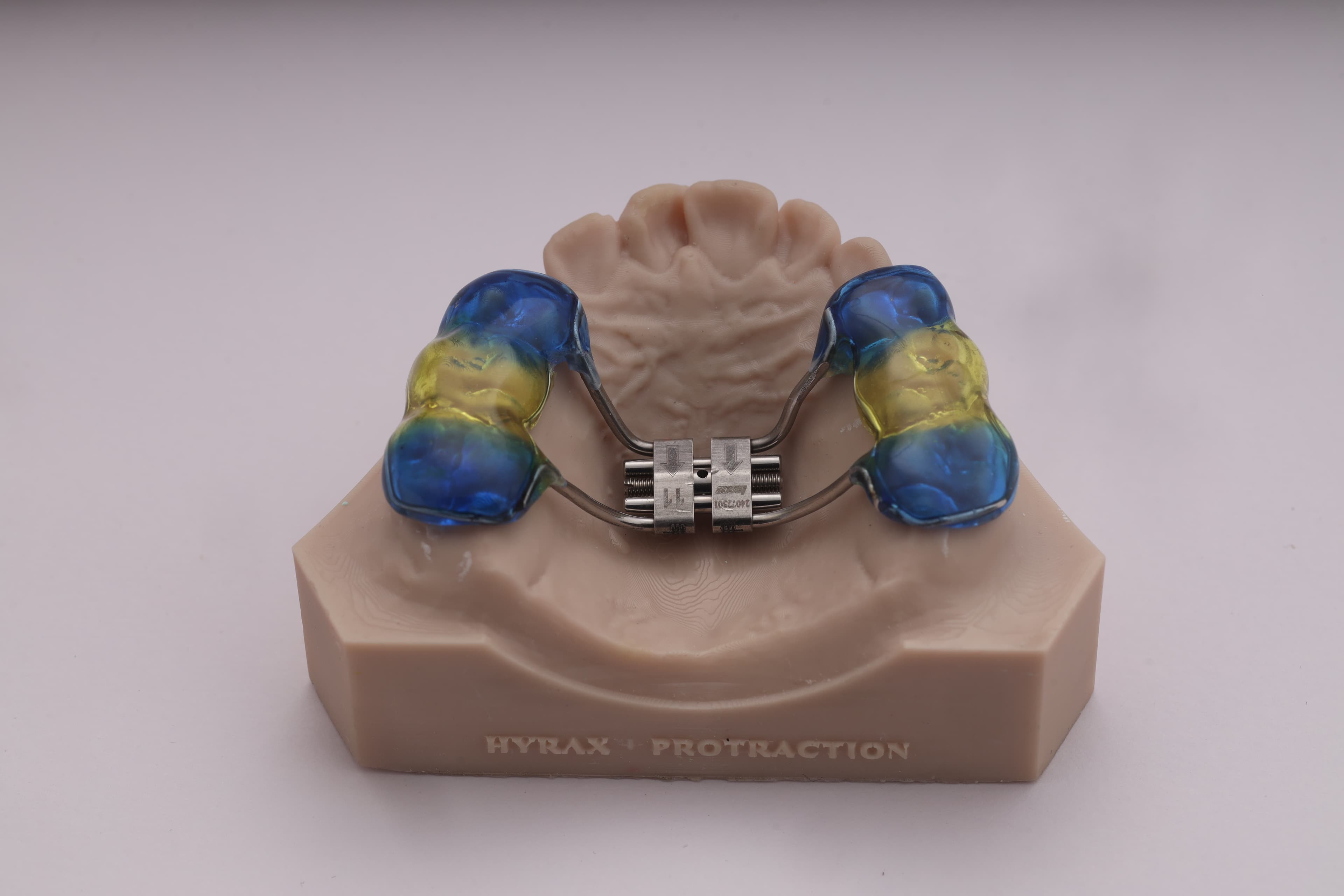
Hyrax Protraction (Banded)
Indications:
Skeletal Class III malocclusion with maxillary retrusion.
Anterior crossbite in growing patients (esp. 7–12 yrs, prepubertal).
Maxillary constriction + Class III → often used with facemask therapy.
Patients requiring circummaxillary suture disarticulation before protraction.
Contraindications:
Non-growing patients (after skeletal maturity).
Severe mandibular prognathism requiring orthognathic surgery.
Poor oral hygiene, periodontal compromise, or caries in anchorage teeth.
Severe vertical growers (risk of bite opening with protraction).
Corrects:
Produces skeletal maxillary protraction (forward/downward displacement).
Relieves anterior crossbite by advancing the maxilla.
Expands maxillary arch transversely (if screw activated).
Improves facial profile (midface projection).
Design:
Bands cemented on maxillary first molars ± premolars.
A Hyrax-type jackscrew in mid-palate → for rapid expansion (0.25 mm/turn).
Heavy wire framework connects molar bands and screw, forming a rigid splint.
Hooks or facemask attachments soldered near canine/premolar region → for elastic traction to facemask.
Provides both transverse expansion + anterior protraction capability.
Philosophy:
Expansion screw activation disarticulates circummaxillary sutures → facilitates forward movement of maxilla.
Protraction elastics (350–450 g/side, 30° downward-forward vector from canine hooks to facemask) → move maxilla anteriorly.
Appliance philosophy: “disarticulate and displace” → expansion + orthopedic protraction.
Modifications:
Bonded protraction splint (covers occlusal surfaces → vertical control).
Semi-rapid expansion protocol for controlled skeletal + dental effects.
Hybrid MARPE-protraction splint → uses skeletal anchorage for older patients.
Can combine with facemask, reverse headgear, or Class III elastics (in skeletal anchorage cases).
Advantages:
· Fixed, compliance-free functional appliance – works continuously without relying on patient cooperation.
· Effective Class III correction – promotes maxillary advancement and improves overjet.
· Maintains molar anchorage – banded design ensures stability.
· Durable and robust – suitable for long-term use.
· Reduces treatment time for mandibular advancement compared to removable functional appliances.
· Versatile activation – can be adjusted for stepwise mandibular advancement.
Can be combined with fixed appliances for comprehensive orthodontic treatment.